What ERT describes
Electrical resistivity tomography (ERT) reconstructs the distribution of resistivity in the subsurface from measurements taken with electrodes laid out on the surface. The result is an electrical section showing variations in the ground response.
Resistivity variations may be associated with stratigraphic discontinuities, anomalies and buried structures, but the section does not identify materials by itself: it must be interpreted in the context of the site and the question.
Field acquisition
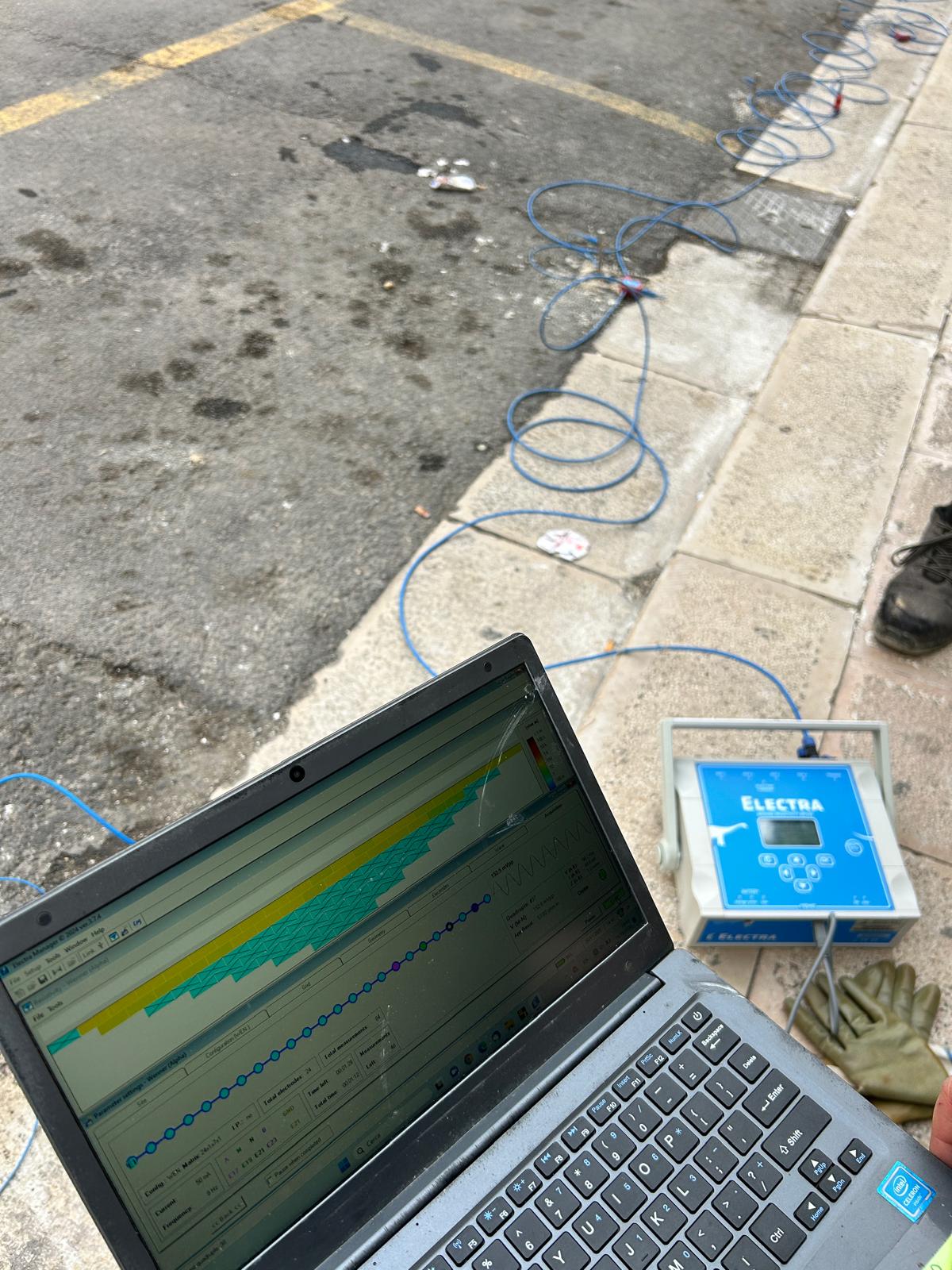
Services documents ERT acquisitions in urban and street settings with an Electra resistivity meter, with electrodes laid out along the survey line. Access, available length and surface conditions shape the survey configuration.
Acquisition geometry should be defined before the survey according to the objective: no single layout suits every site.
When to integrate other methods
ERT, GPR and magnetometry respond to different physical properties: electrical resistivity, reflected electromagnetic signal and magnetic response. Combining them can help compare hypotheses when the question requires it, without the combination being mandatory.
For surveys of concrete structures the reference remains structural GPR, which belongs to non-destructive diagnostics rather than subsurface characterisation.
Related guides
Frequently asked questions
- What do electrical methods measure?
- The electrical response of the subsurface, reconstructed as resistivity distribution along electrical sections.
- Does ERT identify materials directly?
- No. Resistivity variations must be interpreted in the site context and, where useful, compared with other methods.
- Can it be used in urban areas?
- Yes, Services documents urban and street acquisitions; the configuration depends on the available space and site conditions.
- Must it always be combined with GPR?
- No. Integration is assessed against the question; each method responds to different physical properties.
What information does your project need?
Share the objective, site constraints and required deliverables so we can assess an appropriate survey strategy.
Submit your case