One shared question, different physical responses
Integration means selecting complementary information rather than accumulating instruments. GPR, magnetometry and electrical resistivity respond to electromagnetic contrasts, magnetic variations and electrical resistivity distribution respectively.
The strategy starts from the project boundary and archaeological hypotheses shared with the appointed team. Area, access and ground conditions determine feasibility and sequencing.
Extensive survey and targeted follow-up
One method may provide an extensive initial assessment followed by targeted acquisition over selected anomalies. This is not a fixed sequence: it may be reversed or reduced after site feasibility checks.
Electrical resistivity, already included in Services, may be useful when the question concerns resistivity contrasts. Electrode contact, acquisition layout and model interpretation require a specific survey design.
Compare without forcing agreement
Georeferencing and a common boundary allow different responses to be compared. Each output retains its own scale, resolution and quality: cartographic overlay does not make datasets equivalent.
Agreement and disagreement both need discussion. An anomaly seen by only one method may be meaningful or reflect sensitivity and disturbance. Reporting must distinguish these possibilities.
Existing evidence and subsequent decisions
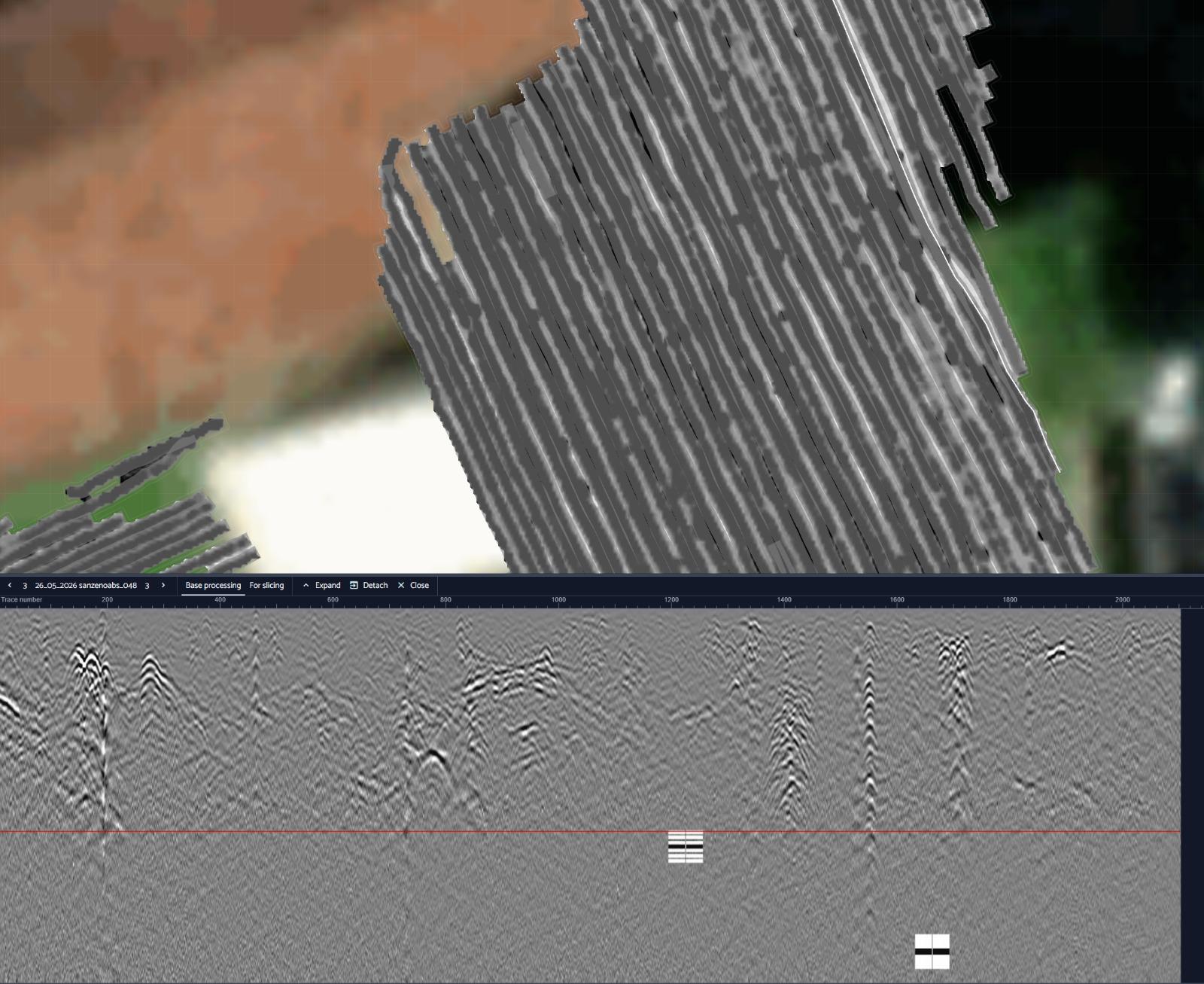
The project already contains geophysical maps over orthophotos, time slices and GPR outputs showing pillar foundations at the Porticus Duplex. These illustrate different readings without adding undocumented results or attributions.
Deliverables should identify areas for further investigation, uncertainty and coverage limitations. Archaeological decisions and documents remain the responsibility of the appointed professional and competent authorities.
Related guides
Frequently asked questions
- Is integration always necessary?
- No. A method is added only if it addresses an unresolved question or checks a relevant hypothesis.
- Should maps show the same anomalies?
- No. Different methods have different sensitivities; both disagreement and agreement need interpretation.
- Do surveys replace archaeological verification?
- No. They supply instrumental evidence supporting the archaeologist rather than replacing that professional’s responsibilities.
What information does your project need?
Share the objective, site constraints and required deliverables so we can assess an appropriate survey strategy.
Submit your case