Context and objective
The case concerns the through-arch bridge over the Garigliano River at km 156-250 of the S.S. 7 ‘Via Appia’, in Minturno (LT). The campaign aimed to characterise the structure dynamically: natural vibration frequencies, damping and mode shapes.
The recordings were acquired on 11 May 2020. This was a test and dynamic identification campaign, not a permanent continuous monitoring system. The continuous recording mentioned in the report refers to the acceleration acquisition during the tests.
Source: report, pp. 1, 4, 15.
The structure and experimental campaign
The bridge is made of reinforced concrete. Its central span is approximately 50.85 m long; the two end spans are approximately 12 m each. The overall length is approximately 75 m and the deck width approximately 9 m.
The report describes a broken hanger cable following a collision with a vehicle. The tests document the structural behaviour under the conditions of the campaign; outcomes of subsequent interventions are not reported here.
For the first two setups, Operational Modal Analysis (OMA) was initially performed by recording ambient noise alone. An impulse was then applied to the deck by making a truck with a stated weight of 20 t drop abruptly from a wooden sleeper. This describes only the documented test, not a general operating protocol.
Source: report, pp. 15, 22, 35.
Acquisition and sensor arrangement
The report describes ambient accelerations arising from natural bridge excitation: wind, microseisms and traffic on nearby roads. Ambient recordings are distinguished from the truck-impulse recordings, which appear separately in the appendices.
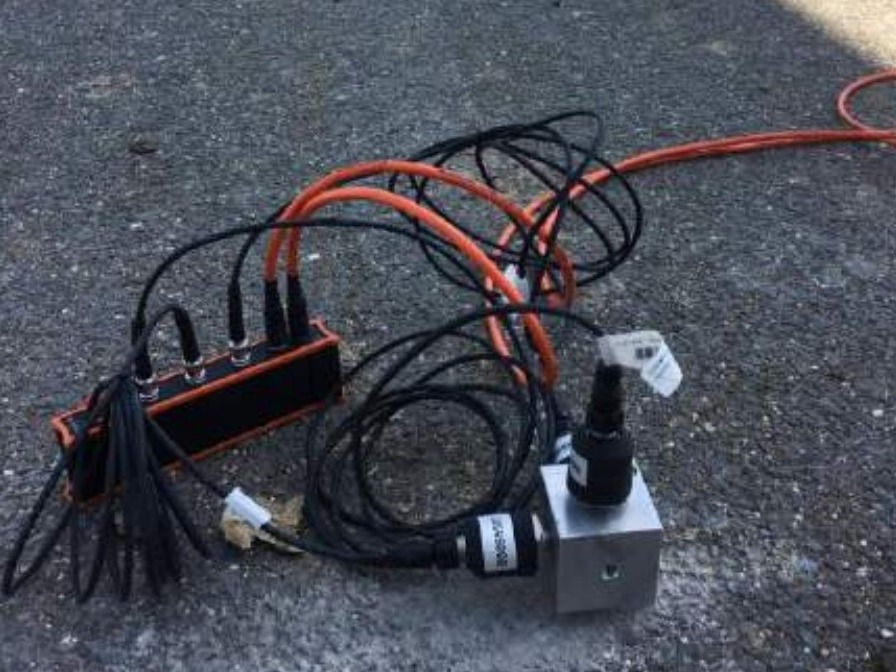
The instrumentation described includes 393B12 and KB12VD-MMF series IEPE seismic accelerometers and seven four-channel KRYPTON-4xACC acquisition units. The acquisition chain includes EtherCAT CAT 6 connections, a 24-bit DSP and an analogue anti-aliasing filter.
Sensor positions were varied across the three layouts illustrated in Figures 7, 9 and 12. Three sensors, N15, N18 and N43, remained in the same positions: the report identifies them as references for synchronising the tests and maximising the information obtained. Individual hanger-cable measurements are documented separately.
Source: report, pp. 4, 10, 12, 14–22.
Processing and dynamic identification
The stated preprocessing comprises exporting acceleration records for each channel, a 0.5–50 Hz band-pass filter, removal of sequences containing anomalous peaks and decimation by a factor of 20, from 1,000 Hz to 50 Hz. These values are reproduced as reported, without correcting or reconstructing steps that are not explicit in the source.
Identification uses Stochastic Subspace Identification (SSI) in the time domain. Stable-mode selection compares frequency, damping and mode shape through MAC across model orders; the stabilisation diagram distinguishes structural modes from purely numerical modes. Figure 17 is labelled with model order 120 and a 50 Hz sample rate.
The report also presents the signal frequency contents obtained through FFT and refers to the appendices. Frequency-content analysis and SSI identification are presented as distinct steps in data processing.
Source: report, pp. 24–27.
Results: frequencies, damping and mode shapes
Table 1 of the report gives six main experimental bridge frequencies and their modal damping values. The following table reproduces the values without additional rounding.
The modal model is a schematic representation of the structure, with no information on materials or boundary conditions. Modal-vector magnitude and phase describe the relative movement of measured points, in phase or out of phase. This is not a numerical structural verification of the materials.
Figure 20 shows the geometric model and measurement directions; Figures 21–26 represent the six mode shapes, in the frequency order of Table 1. The report also presents complexity plots and AUTOMAC. No individual mode-shape classifications absent from the source are added.
| Mode | Frequency [Hz] | Damping [%] |
|---|---|---|
| 1 | 3.689 | 2.106 |
| 2 | 4.909 | 1.905 |
| 3 | 5.641 | 1.293 |
| 4 | 10.760 | 1.894 |
| 5 | 12.428 | 0.983 |
| 6 | 22.774 | 1.598 |
Source: report, pp. 26–32.
Focus on the hanger cables
The report provides a separate dynamic identification of the individual hanger cables, with time histories and FFT in Appendix 6 and parameters in Table 2. Cable 04 is marked as damaged and has no numerical identification values in the table.
Examples from Table 2 include: cable 01, first mode, 60.626 Hz; cable 20, second mode, 66.910 Hz; cable 23, first mode, 6.403 Hz. The cable mode shapes are described as bending modes perpendicular to the direction of the cables.
Cable results remain distinct from the global bridge parameters. The 50 Hz decimation chain described for global processing is not automatically extended to cable results: the source does not explicitly reconstruct that processing step here.
Source: report, pp. 22, 32–34.
What the campaign characterised
The measurements highlighted the main dynamic characteristics of the system: natural frequencies, associated damping and structural mode shapes, together with the separate cable results. The conclusions describe the signal frequency content as clearly evident.
The case documents characterisation under the test conditions. The report is not used to infer a safety judgement, a repair outcome or an undocumented post-intervention comparison.
Source: report, pp. 27–35.
Conclusions
The report concludes that the campaign assessed the bridge's structural responses and that data processing obtained mode shapes associated with the main natural vibration frequencies.
Its final recommendation is to perform a new dynamic identification of the bridge after repairing the cable involved in the accident. A subsequent comparison campaign is not documented in this case.
Source: report, pp. 35.
Agreement and documented roles
The report concerns the agreement between Università Politecnica delle Marche (DICEA) and Novatest S.r.l. for technical-scientific consultancy on processing survey data from existing structures. Novatest S.r.l. is identified as the commissioning party; Università Politecnica delle Marche, Department of Civil, Building Engineering and Architecture, as consultant. The scientific lead is Prof. Francesco Clementi, with Gianluca Standoli as collaborator. The acquisition date belongs to the documented campaign; the entire campaign is not attributed to Novatest Engineering, which presents this editorial case study.
Source: report, p. 1.
Survey campaign
In May 2020 Novatest took part in a dynamic identification campaign on the arch bridge over the Garigliano, aimed at characterising the dynamic behaviour of the structure.
The work involved acquiring vibrations through a network of accelerometers and processing the signals to identify the main dynamic characteristics of the structure, including natural frequencies, damping and mode shapes. The survey also examined the behaviour of the hanger cables in relation to the condition of the structure at the time of the campaign.