Natural frequencies
The frequencies at which the structure tends to vibrate.
Identifying how a structure characteristically vibrates from measured vibrations.
Modal analysis returns the dynamic parameters of a structure in one or more measurement campaigns; it is not the same as continuous monitoring, which follows quantities over time.
Every structure has natural frequencies and mode shapes describing how it responds to vibration. Modal analysis identifies them from accelerations measured with accelerometers.
With operational modal analysis (OMA) identification takes place under service conditions, using ambient excitation; techniques include Stochastic Subspace Identification (OMA-SSI).
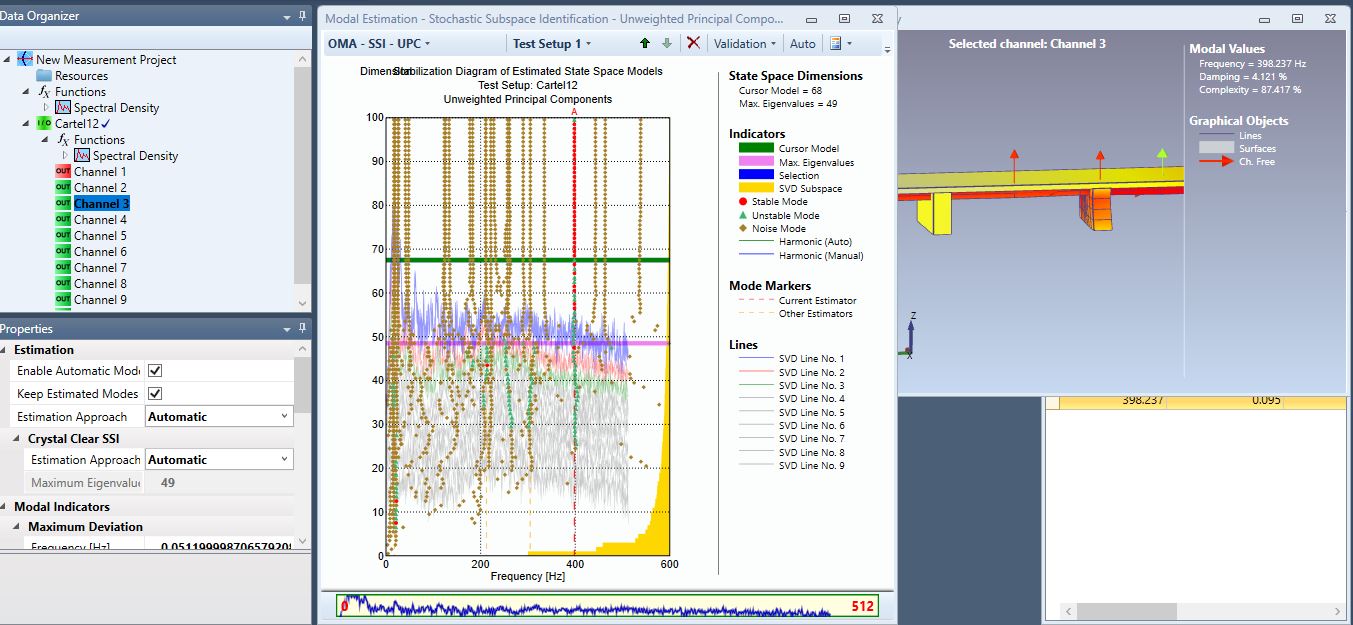
The frequencies at which the structure tends to vibrate.
The deformed configuration associated with each mode.
Estimated dissipation associated with the identified modes.
Reading the behaviour of the structure under operational excitation.
Where relevant, comparing measured parameters with the numerical model to calibrate it.
Reference parameters to compare with future campaigns or monitoring.
Identified modal parameters must be read in the context of the structure, the measurement layout and the operating conditions at the time of acquisition.
Identification of a deck's frequencies and mode shapes from operational vibrations.
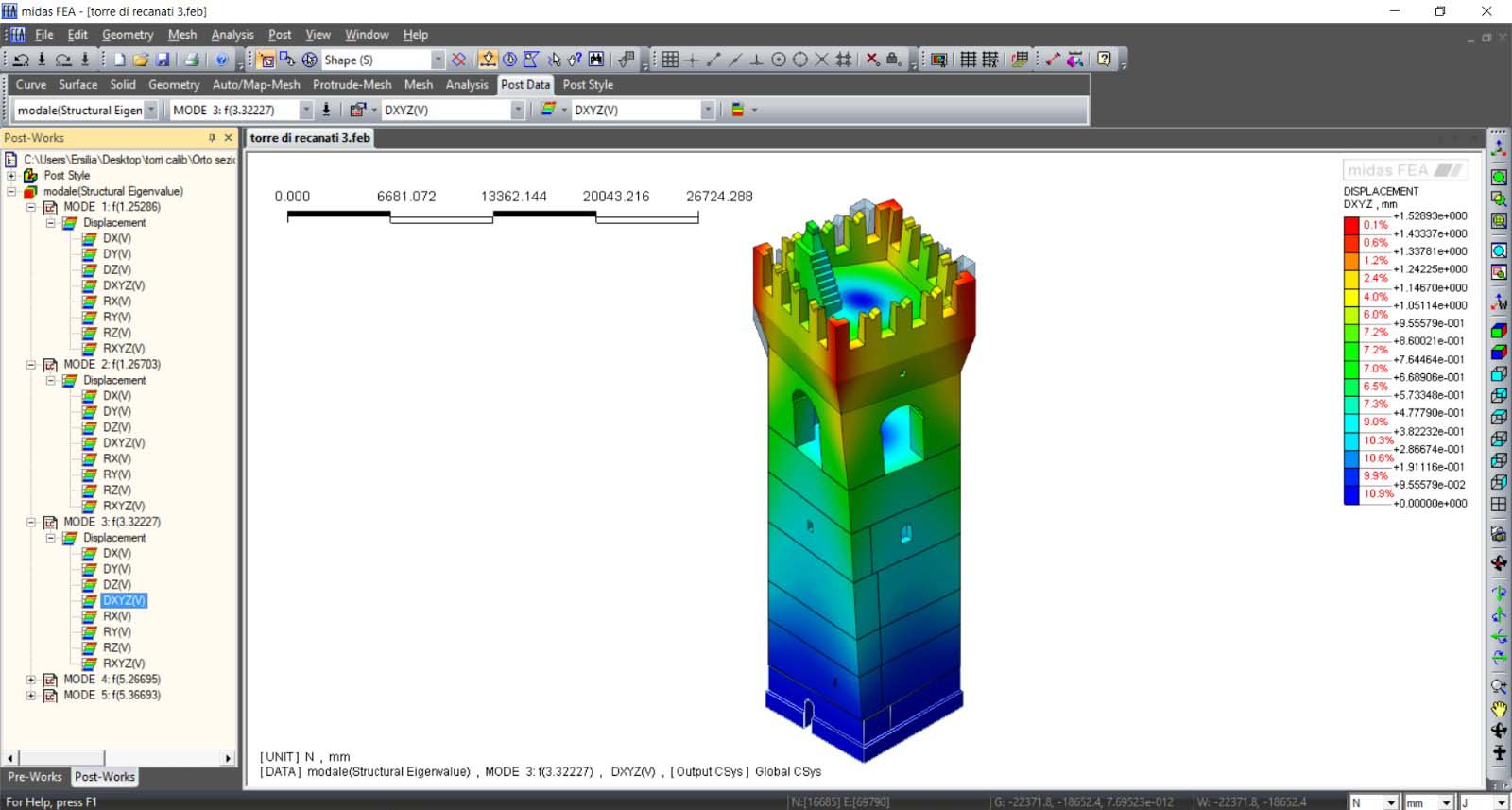
Mode shapes and natural frequencies of the numerical model for comparison with measured parameters and calibration.
Further topics in the monitoring cluster and the comparison with point-in-time diagnostics.
Vibration response observed over time.
Deformations, rotations and cracks over time.
Designing and managing the system.
Point-in-time surveys of materials and geometry.