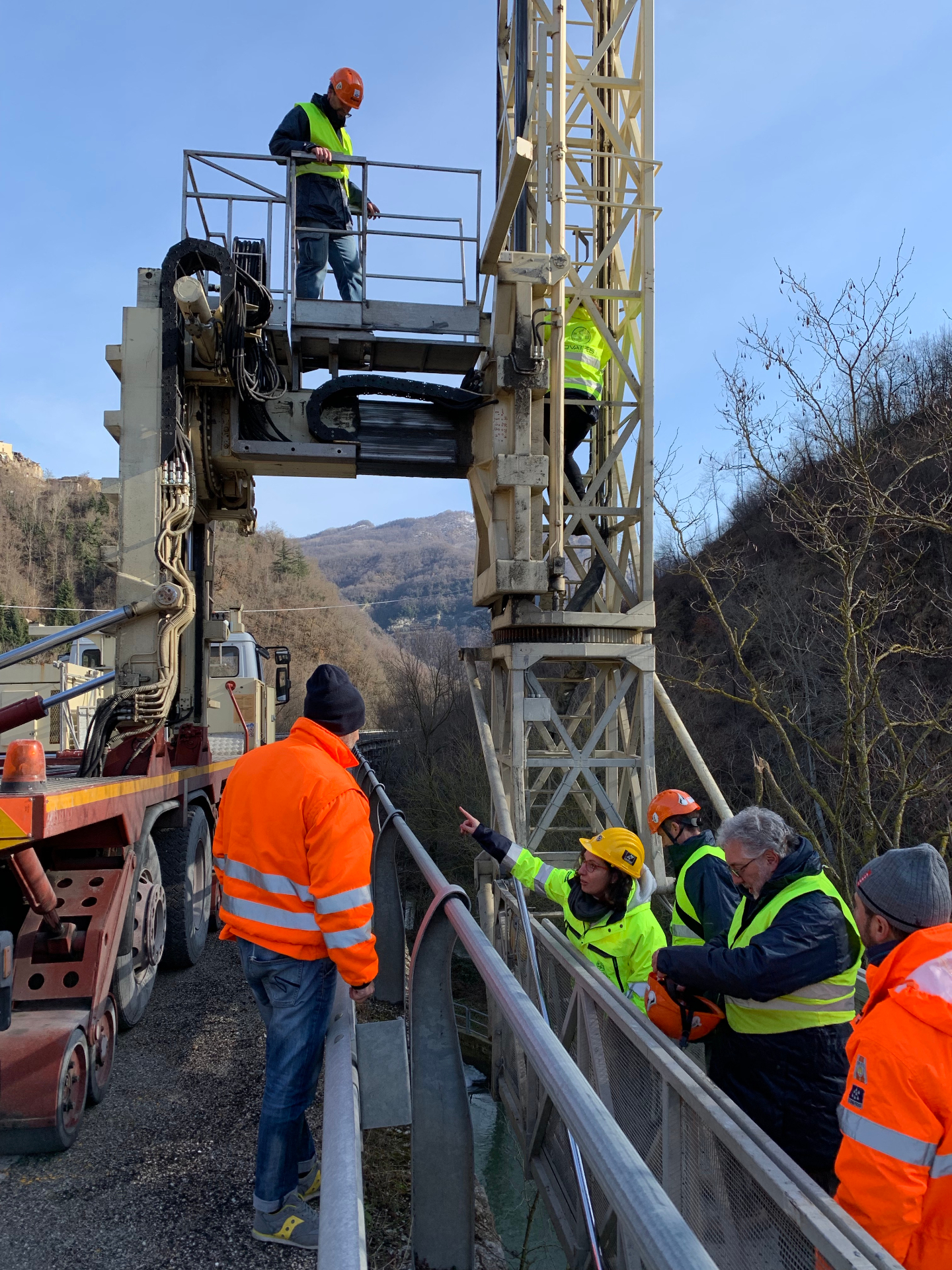
Diagnostic investigations on bridges and viaducts
Understanding the inside of the infrastructure through targeted diagnostic strategies.
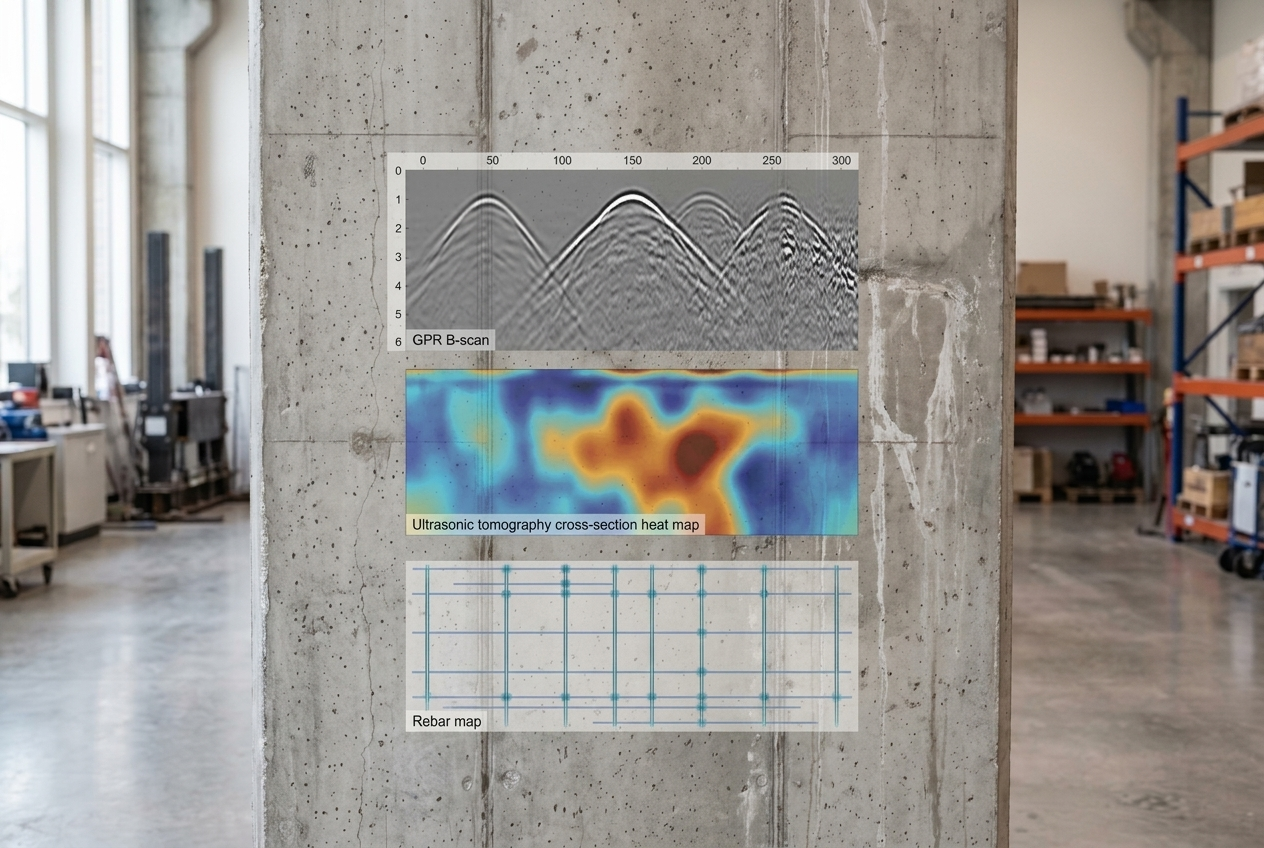
Bridges and viaducts are complex structural systems, in which knowledge of the internal condition of the elements may require information obtainable through different methodologies.
The choice of techniques must be defined according to the objective of the investigation, the characteristics of the structure and the operating conditions.
Why bridges may need an integrated diagnostic approach
An existing infrastructure may require different information: internal geometry, position of reinforcement and prestressing elements, presence of discontinuities, cavities or local anomalies.
There is therefore no single combination of tests valid for every bridge.
The diagnostic strategy must be built according to the questions the investigation is required to answer.
- 01Bridge / viaduct
- 02Diagnostic question
- 03Information needed
- 04Methodology
- 05Interpretation
- 06Data correlation
- 07In-depth investigation
The case of the Via Mario de Bernardi Viaduct
- Client
- Aeroporti di Roma S.p.A.
- Location
- Fiumicino Airport — Via Mario de Bernardi Viaduct
- Campaign
- Demonstrative, from 31 July to 2 August 2019
- Report
- 17/09/2019
The report documents the use of three methodologies: ultrasonic tomography, GPR and digital radiography. The stated objective was to investigate certain structural elements of the viaduct and demonstrate the potential of the methods and instruments used.
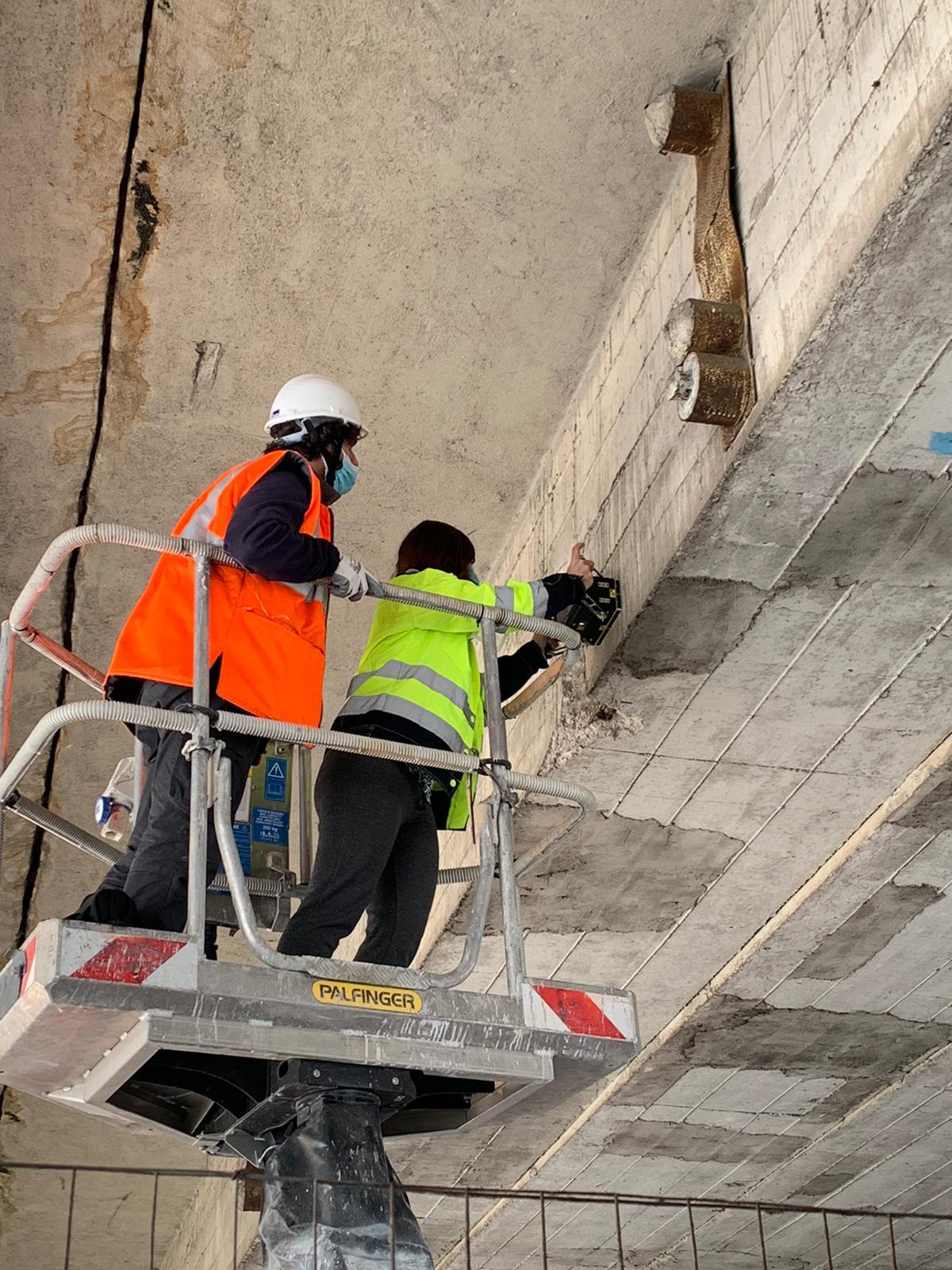
How the investigations on the Via Mario de Bernardi Viaduct were correlated
The diagnostic question was to understand the structural elements investigated, in particular the arrangement of the reinforcement and strands, in order to guide further investigation of the structure. The documented campaign shows how preliminary information can guide the choice of the subsequent acquisition.
- 01 / Preliminary acquisition
GPR defines the qualitative arrangement
With a 2 GHz antenna, 116 radar sections were acquired on the central beam. The vertical profiles, spaced 1 m apart, together with a horizontal profile, helped qualitatively identify the arrangement of the rebars and interpret that of the strands: partial information, not a complete view of the inside of the concrete.
- 02 / Targeted in-depth investigation
GPR data configures the tomography
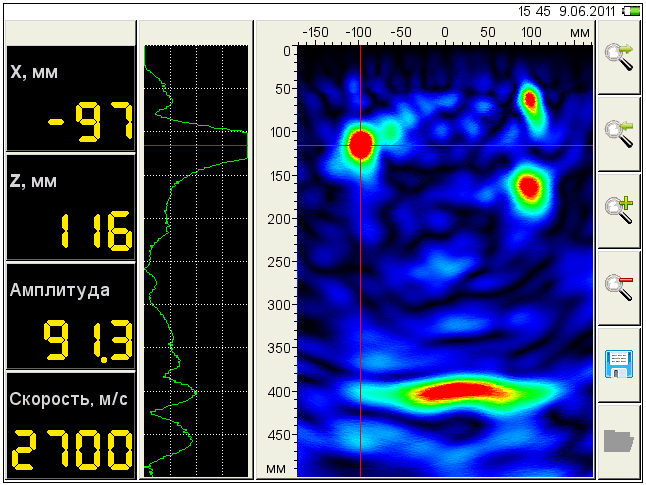
The preliminary information on the internal configuration was used to define the configuration of the tomographic survey. The ultrasonic acquisitions thus provided B-scans to be interpreted together with the available geometric data.
- 03 / Local verification
Radiographic investigations
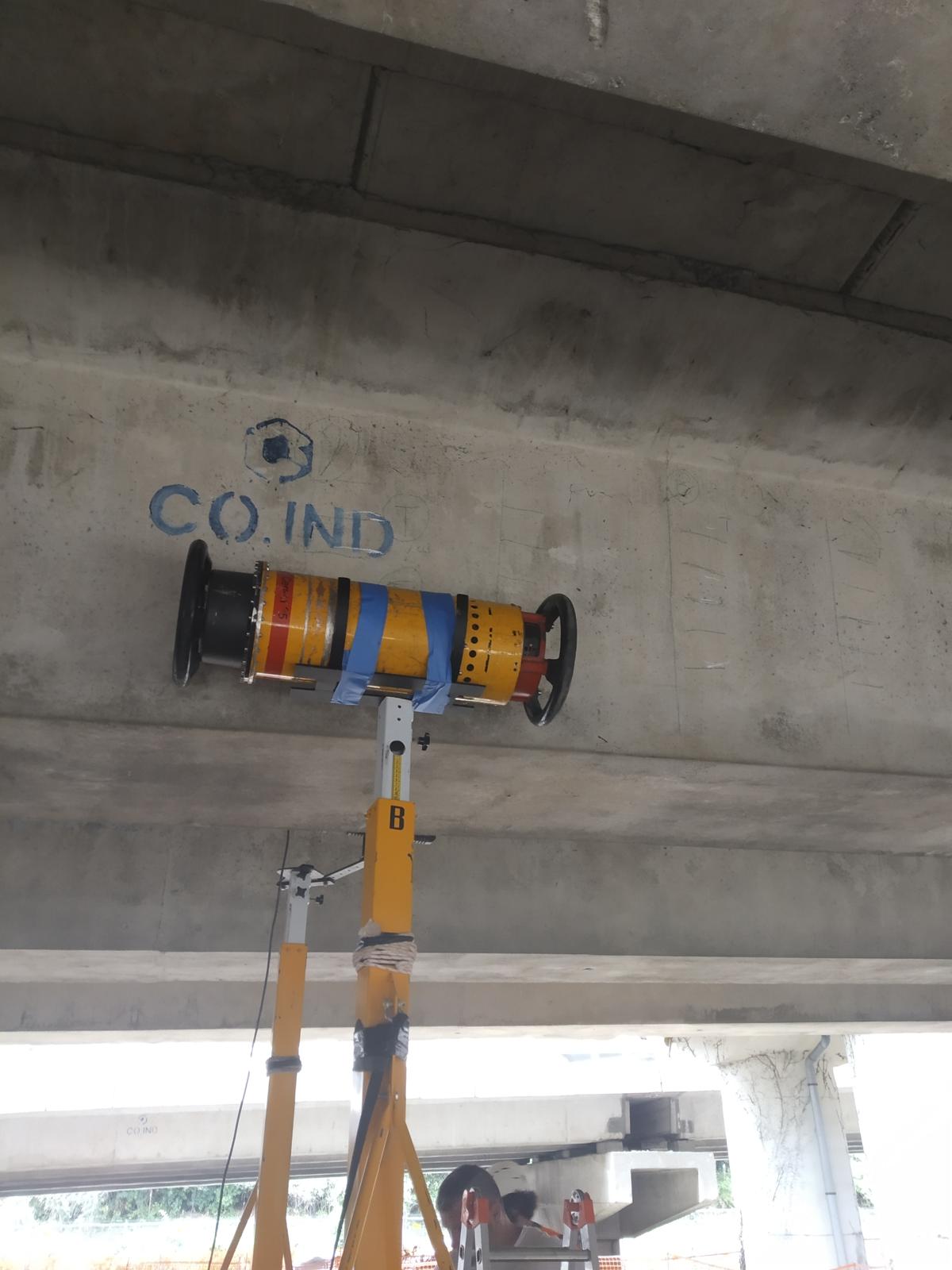
The report documents specific radiographic acquisitions on the central beam and on the bearing elements, as a local in-depth investigation. The use of radiography requires qualified personnel and compliance with the requirements applicable to the technique, to radiological safety and to the operating context; in the industrial sector, the qualification of NDT personnel refers to UNI EN ISO 9712.
- 04 / Overall reading
Correlating the information
The results of the acquisitions are read in relation to the geometry of the element and the information available on the structure. The progression from GPR to tomography and radiographic investigations describes this specific case, not a mandatory sequence for other viaducts.
Tronto IV Viaduct
ANAS S.p.A. — Marche Road Network Division · SS 4 "Salaria", Arquata del Tronto
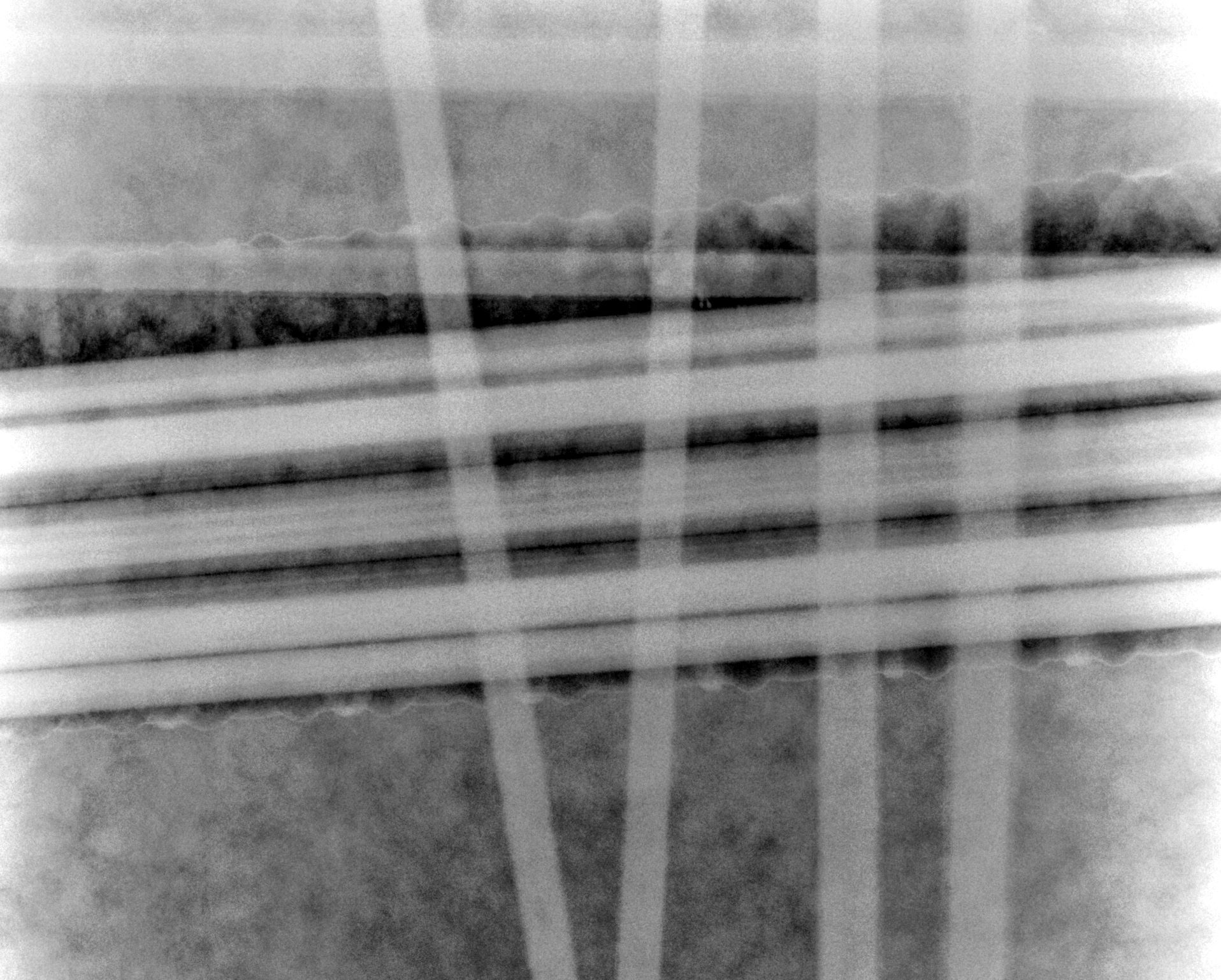
Here the question was narrow: observe cavities, internal honeycombing and the condition of the reinforcement bars, with particular attention to the prestressing strands. The campaign involved 478 radiographic acquisitions: a targeted specialist method, without assuming integration with other techniques.
The diagnostic strategy does not depend on the number of techniques available, but on the information required.
Explore the methodologies
Frequently asked questions
- Must GPR, ultrasonic tomography and radiography always be used together?
- No. They do not form a standard procedure. Different methodologies can be combined when complementary information is needed; in other cases a targeted specialist campaign may be the most appropriate choice.
- How is the methodology chosen for a bridge?
- The starting point is the diagnostic question and the information required, taking into account the structure's characteristics, accessibility, safety and operating conditions. The methodology follows from the investigative objective.
- What role can GPR play in a viaduct campaign?
- In the Via Mario de Bernardi case, preliminary GPR profiles were used as a support for interpreting the arrangement of the strands and for defining the configuration of the tomographic survey.
- When is digital radiography useful?
- It can be used as a highly detailed local specialist investigation, for example to observe cavities, honeycombing or the condition of rebars and strands in specific areas. It is not a mandatory technique.
Do you need to define a diagnostic campaign on a bridge or viaduct?
Describe the infrastructure to us, the problem to be investigated and the information you need to obtain. We can help you define a diagnostic strategy consistent with the objectives of the investigation.
Talk to a Novatest technicianSubmit your caseNovatest technical updates
Receive new guides, application cases and standards updates. No unsolicited commercial messages.
Data is processed according to our privacy policy. You can unsubscribe at any time.