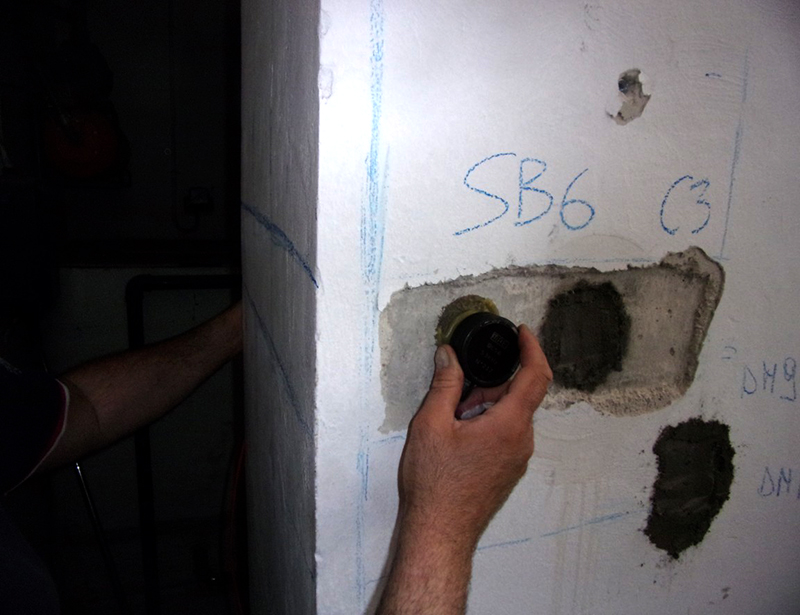
Rebound Hammer and SonReb Testing
Assessing concrete through indirect and correlated measurements.
Rebound hammer and ultrasonic testing provide different information. Combining them can improve interpretation when the correlation is designed for the specific concrete and survey.
What rebound hammer testing is
The rebound hammer records the rebound of a spring-loaded mass against the concrete surface. The rebound index is related to the surface response and hardness: it is useful for comparing homogeneous areas and identifying variations, but it is not a direct measure of compressive strength.
The result is affected by surface conditions, moisture, orientation, carbonation, roughness, aggregate type and local conditions.
What ultrasonic testing adds
Conventional ultrasonic measurement detects the speed at which a pulse propagates through the concrete. This response helps assess continuity and homogeneity; however, it is affected by moisture, geometry, reinforcement, transducer coupling and material characteristics.
Here the pulse propagation velocity is considered, not pulse-echo tomography, which reconstructs information about the internal configuration.
Learn more about ultrasonic tomographyHow SonReb works
Rebound index
Propagation velocity
SonReb jointly reads two physically different parameters. Its usefulness depends on the choice and validation of the correlation for the specific concrete: it is not a mechanical conversion nor a universal measure of characteristic strength.
When it is useful
- Preliminary assessment and mapping of concrete homogeneity
- Comparison between areas of the same element under comparable conditions
- Identification of areas requiring further investigation
- Support for broader diagnostic campaigns
- Integration with cores and direct tests when required by the project
Limitations and influencing factors
Comparability of data requires attention to the conditions of the component, the surface and the measurement.
- Surface, finish and roughness
- Moisture and carbonation
- Age and curing
- Aggregate type
- Testing direction
- Geometry and thickness
- Presence of reinforcement
- Transducer coupling
- Correlation and validation
SonReb, GPR and tomography: different information
Each technique answers a different question. Integration makes sense only when it adds information useful to the diagnostic project.
| Method | Main information |
|---|---|
| Rebound hammer testing | Surface response and relative hardness |
| Ultrasonic testing | Propagation and material homogeneity |
| SonReb | Correlation of two physically different parameters |
| Structural GPR | Geometry and internal elements |
| Ultrasonic tomography | Discontinuities and internal configuration |
Novatest diagnostic approach
The starting point is the information required, not a predefined formula. The measurements are designed and read together, taking into account the conditions of the element and the limitations of the methods.
- 01Definition of the objective
- 02Coordinated acquisition
- 03Comparison of measurements
- 04Interpretation
- 05Possible further investigations
Technical references
EN 12504-2
Testing concrete in structures using a rebound hammer.
EN 12504-4
Determination of ultrasonic pulse velocity in concrete.
EN 13791
Assessment of in-situ compressive strength: indirect correlations must be contextualized within the assessment framework.
For requirements and applicability, consult the official versions of the standards relevant to the project.
Frequently asked questions
- What does the rebound hammer measure?
- It measures a rebound index related to the response of the concrete surface. It does not directly measure compressive strength.
- Does SonReb directly measure concrete strength?
- No. It relates rebound index and ultrasonic pulse velocity through a correlation appropriate to the concrete and the survey conditions, for an indirect assessment. It does not automatically provide the characteristic strength.
- Why combine the rebound hammer and ultrasonic testing?
- The two measurements describe different physical responses: rebound is sensitive to the surface, while ultrasonic pulse velocity relates to propagation within the material. A combined reading can improve interpretation if the correlation is designed and validated for the specific case.
- What factors can affect the measurement?
- Among others: finish and roughness, moisture, carbonation, age of the concrete, aggregate type, testing direction, geometry, reinforcement, and coupling of the ultrasonic transducers.
- When are direct tests or further investigations needed?
- When the diagnostic objective requires an on-site strength assessment, or when indirect measurements are not sufficient on their own. The survey plan may include cores and direct tests to correlate or verify the results.