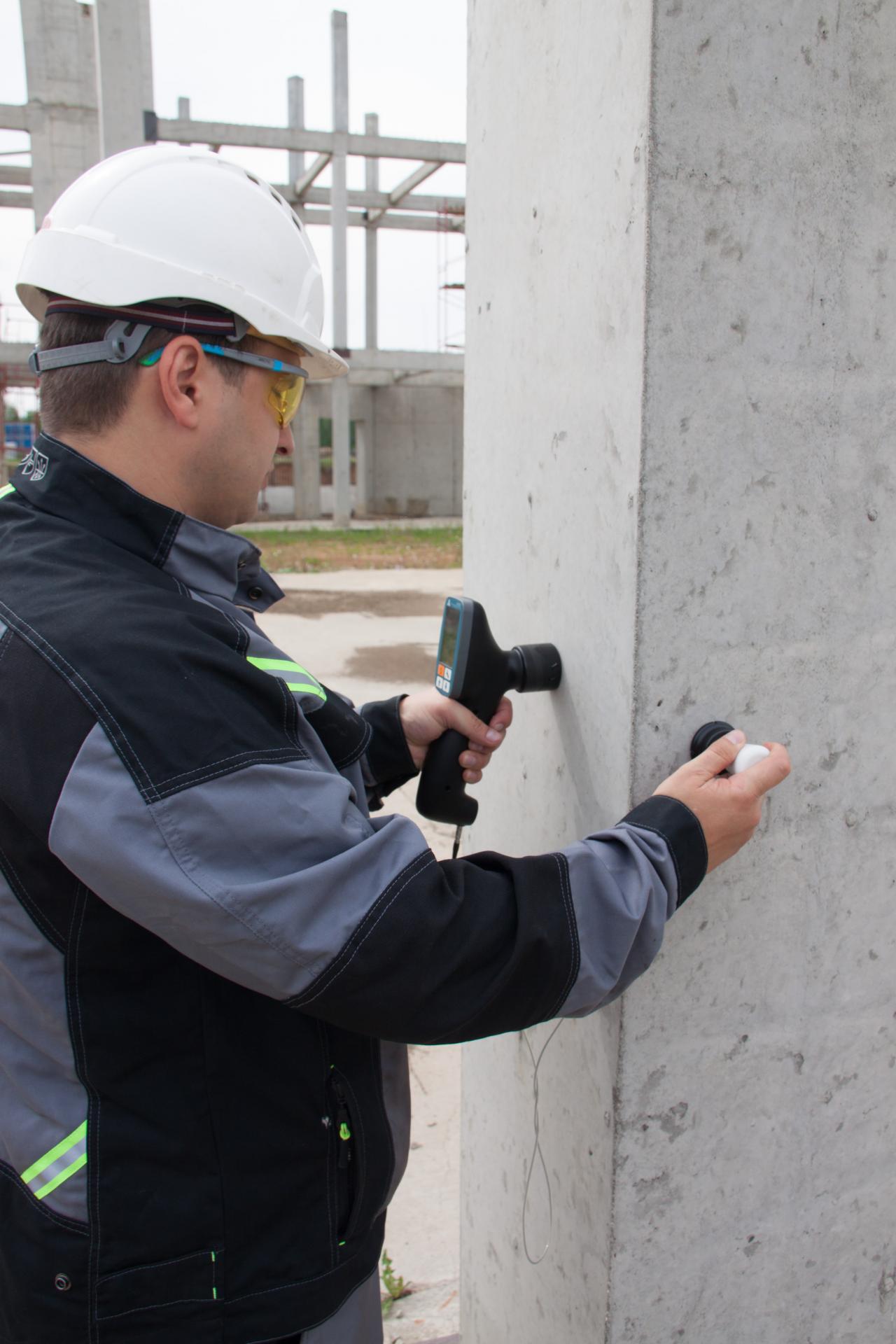
Ultrasonic testing of concrete: material characterisation and control
Ultrasonic testing analyses the propagation of elastic waves through the material to assess its homogeneity and identify internal anomalies.
Conventional measurement detects the speed at which an ultrasonic pulse propagates through the concrete: a physical response that requires interpretation and which, on its own, does not determine characteristic strength.
What ultrasonic testing measures in concrete
Conventional ultrasonic measurement determines the propagation velocity of ultrasonic pulses in concrete. Elastic waves travel through the material and their velocity depends on the characteristics of the medium they cross.
This response helps assess the continuity and homogeneity of the material; however, it is affected by moisture, geometry, reinforcement, transducer coupling and the characteristics of the concrete.
Diagnostic objectives
Ultrasonic velocity measurement supports several diagnostic purposes, always within a defined survey programme.
- Assessment of material homogeneity
- Identification of internal anomalies and discontinuities when supported by the measurement
- Comparison between different zones of the same element or between similar elements
- Support for the indirect assessment of mechanical properties, in combination with other tests
How to interpret the data
Ultrasonic velocity is an indirect index: comparable values indicate similar conditions, while significant variations may signal zones with different characteristics. Interpretation requires comparison between measurements and knowledge of the testing conditions.
A correlation appropriate to the concrete and the survey conditions can support an indirect assessment of mechanical properties. Characteristic strength does not derive automatically from ultrasonic measurement alone.
Factors affecting the measurement
The measured velocity depends on numerous factors that must be considered in the interpretation.
- Surface finish and roughness
- Concrete moisture
- Carbonation
- Age of the concrete
- Aggregate type
- Testing direction
- Geometry of the element
- Presence of reinforcement
- Transducer coupling
Limits of the method
Ultrasonic measurement provides indirect information averaged along the pulse path. It does not reconstruct the internal geometry of the element and does not replace direct testing of the material.
When the objective is a representation of the element's interior, ultrasonic tomography is used; when an indirect estimate of mechanical properties is needed, the measurement can be combined with the rebound hammer in the SonReb method.
Ultrasonic testing and the rebound hammer: the SonReb method
Rebound hammer and ultrasonic testing provide different information: rebound is sensitive to the surface, while ultrasonic velocity relates to propagation within the material. Combining them can improve interpretation when the correlation is designed and validated for the specific concrete and survey.
The SonReb method relates rebound index and ultrasonic velocity through an appropriate correlation, for an indirect assessment: it does not automatically provide the characteristic strength.
Learn more about rebound hammer testing and SonRebUltrasonic testing and ultrasonic tomography
Ultrasonic tomography is an advanced technique that analyses the reflections of ultrasonic waves generated in the material to build a three-dimensional or sectional representation of the element's interior.
The velocity measurement described here considers pulse propagation along a path; pulse-echo tomography instead reconstructs information about the internal configuration. The two applications serve different diagnostic objectives.
Learn more about ultrasonic tomographyWhen to choose the method
The choice depends on the information that needs to be obtained.
| Method | Main information |
|---|---|
| Ultrasonic testing (propagation velocity) | Material homogeneity and comparison between zones; support for indirect assessments. |
| GPR | Position and geometry of reinforcement and embedded elements, with high productivity over large surfaces. |
| Ultrasonic tomography | Sectional or three-dimensional reconstruction of the element's interior and its discontinuities. |
| Rebound hammer and SonReb | Indirect estimate of mechanical properties through appropriate correlations. |
Frequently asked questions
- Does ultrasonic testing directly measure concrete strength?
- No. Ultrasonic measurement detects the propagation velocity of pulses through the material. A correlation appropriate to the concrete and the survey conditions can support an indirect assessment, but characteristic strength does not derive automatically from ultrasonic measurement alone.
- What is the difference between ultrasonic testing and GPR?
- GPR uses electromagnetic waves and is particularly effective at locating metallic elements and discontinuities with high productivity over large surfaces. Ultrasonic testing uses elastic waves and is oriented towards material characterisation.
- What is the difference between ultrasonic measurement and ultrasonic tomography?
- Conventional ultrasonic measurement detects the speed at which a pulse propagates through the concrete. Pulse-echo ultrasonic tomography analyses the reflections of the waves generated in the material to build a sectional or three-dimensional representation of the element's interior.
- Which factors affect ultrasonic measurement?
- Among others: finish and roughness, moisture, carbonation, age of the concrete, aggregate type, testing direction, geometry, reinforcement, and coupling of the ultrasonic transducers.
- Which materials can be investigated with ultrasonic testing?
- Ultrasonic testing is applied to concrete, masonry and stone materials, with procedures and interpretation depending on the material and the configuration of the element.