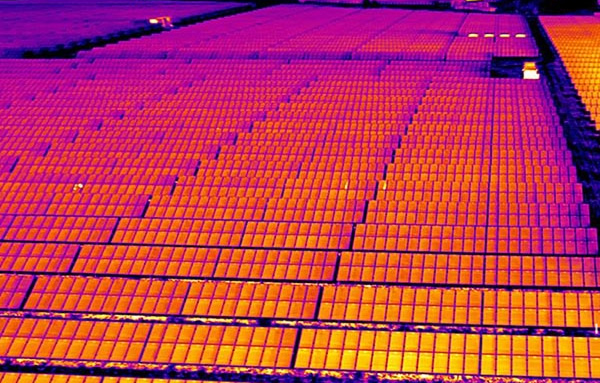
Identify thermal anomalies and support interpretation of phenomena affecting the building envelope.
Thermography examines surface temperature distributions and anomalies: non-invasive support for investigating envelope defects, not automatic diagnosis of their causes.
A thermal camera detects infrared radiation emitted by surfaces and converts it into a spatial distribution of apparent temperatures. Temperature differences can indicate envelope anomalies but do not, on their own, identify their origin.
Environmental conditions and correct acquisition influence interpretation: a thermal image must always be assessed in relation to the surface and its context.
Apparent temperature distribution is data to interpret, not a direct map of causes.
What it can reveal in buildings
Thermal bridges
Envelope areas with a thermal response different from their surroundings.
Uneven insulation
Variations in thermal distribution that may indicate discontinuities in insulation.
Envelope anomalies
Surface differences on walls, roofs and façades that require contextual interpretation.
Moisture and water ingress
Phenomena that may become apparent only when they produce a detectable thermal response.
Surface debonding
Possible discontinuities detectable only under favourable measurement conditions.
Localised anomalies
Areas to delineate when deciding whether further investigation is needed.
From anomaly to diagnosis
01 Thermal anomaly
02 Checking acquisition conditions
03 Interpretation in the construction context
04 Correlation with other investigations where appropriate
05 Technical assessment
Thermography identifies thermal anomalies; diagnosis requires interpreting the phenomenon in its context.
Factors influencing the result
An anomaly can only be interpreted in relation to surface, environmental and acquisition conditions.
Indoor–outdoor temperature difference
Solar radiation and time of day
Wind and weather conditions
Emissivity and surface characteristics
Reflections
Moisture conditions
Element geometry and accessibility
When to combine it with other investigations
It can be used for screening to delineate anomalies; when the diagnostic question requires it, observations can be compared with other direct or non-destructive checks. No combination is mandatory: each method provides different information.
Start with the phenomenon to understand and the construction context. Acquisition is planned under suitable conditions, then anomalies are assessed to provide relevant technical information.
01Defining the phenomenon
02Site visit and assessment of the context
03Acquisition under suitable conditions
04Analysis of anomalies
05Correlation where appropriate
06Technical deliverables
Frequently asked questions
What does a thermal camera detect?
It detects infrared radiation emitted by a surface and represents it as an apparent temperature distribution, which must be interpreted with measurement conditions in mind.
Can thermography detect moisture?
It does not measure moisture directly. It may reveal thermal anomalies associated with moisture or water ingress when they produce a detectable response; further checks are needed to interpret them.
Which building defects can be investigated?
It can support the analysis of thermal bridges, uneven insulation and envelope anomalies, as well as moisture or debonding under favourable conditions. It does not identify the cause on its own.
Why are environmental conditions important?
Temperature differences, sunlight, wind and weather influence surface response and can affect the visibility of anomalies. They must be assessed before interpreting an image.
Is thermography sufficient on its own for a diagnosis?
Not necessarily. A thermal anomaly is an indication that must be interpreted in the building's context and, when required by the diagnostic question, correlated with other checks.
Do you have an anomaly or building defect to investigate?
Describe the phenomenon and its context: we will assess which method can provide the information you need.