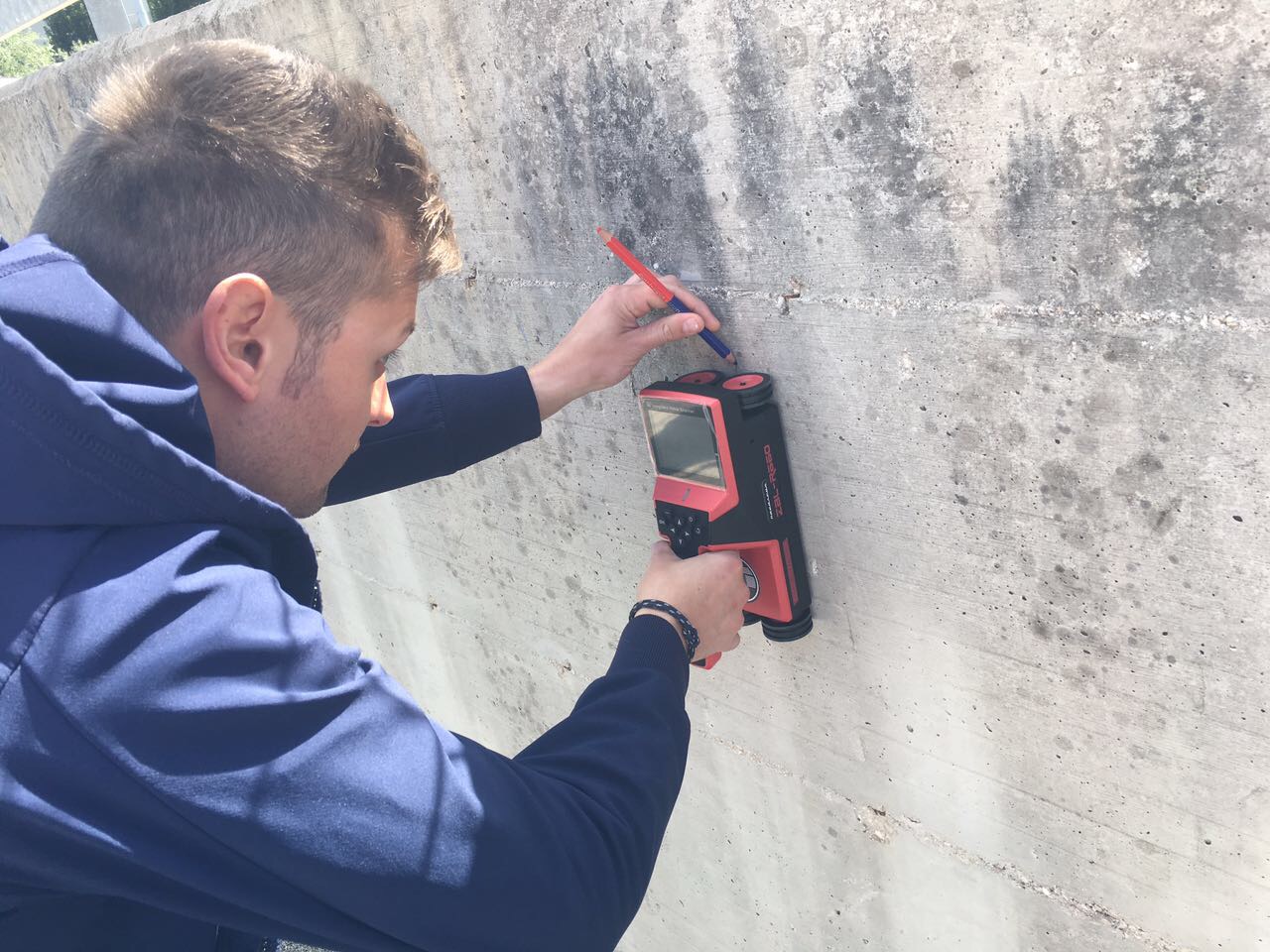
A covermeter generates an electromagnetic field and detects the response of metallic elements in concrete. Surface scans locate reinforcement near the accessible face and estimate its cover.
Diameter can only be estimated using instruments that support it and under suitable measurement conditions. The method does not, on its own, reveal the element's complete internal configuration.
Mapping concerns metallic elements detectable from the accessible surface.
What it can detect
Reinforcement position
Locating bars close to the accessible surface.
Concrete cover
Estimating the distance between the bars and the surface, subject to measurement conditions.
Bar distribution
Assessing spacing and arrangement when individual bars can be distinguished.
Near-surface metallic elements
Identifying possible metallic inserts within the accessible investigation area.
Intervention planning
Supporting the choice of coring and drilling locations, with the necessary verification.
Preliminary configuration
Initial indications of reinforcement arrangement in the investigated portion.
Covermeter surveying and GPR: different information
No technology is universally best. Covermeter surveying targets near-surface metallic elements; GPR can provide a wider view of geometry, internal elements and anomalies, with performance depending on the context and investigation configuration.
Local question
Covermeter surveying
Targeted investigation of near-surface metallic elements and estimation of concrete cover.
Extended area / wider configuration
GPR
Investigation of geometry, internal elements and possible anomalies; depth and performance depend on the configuration.
Information to correlate
Integration
Complementary methods only when the diagnostic question requires them.
The choice starts with the information required, not the instrument available. Mapping and results are interpreted in the element's context to guide any further investigations.
It detects the electromagnetic response of metallic elements near the concrete surface. The data helps locate reinforcement and estimate cover; it does not, on its own, reconstruct the complete internal configuration.
Can covermeter surveying estimate concrete cover?
Yes, it can estimate the distance between the surface and detected bars. The result depends on depth, reinforcement arrangement, concrete and the instrument used.
What is the difference between covermeter surveying and GPR?
Covermeter surveying focuses on near-surface metallic elements and concrete cover; GPR can investigate wider areas and internal configurations. The choice depends on the information required and the condition of the element.
Can covermeter surveying determine bar diameter?
Only some instruments can estimate diameter, and only under suitable measurement conditions. This is neither a universal capability nor a value to assume without verification.
When is covermeter surveying appropriate?
When reinforcement needs to be located locally and cover estimated, for example to guide mapping or plan an intervention. Combining it with other investigations is a diagnostic choice, not a mandatory step.
Do you need to understand reinforcement arrangement before an intervention or investigation?